Service

AI automation for the boring bits.

For owners whose week disappears into copying, pasting and chasing. We put the boring bits on rails, day and night, with a person signing off where it matters.

AI automation

“Our team doesn’t know how to use any of this.” With automation, they don’t need to. It lives inside the tools they already use: the enquiry lands, the CRM updates, the reply is drafted and the right person gets a nudge.

Automation is the part of AI that doesn’t need a conversation. It follows the same steps every time and it doesn’t forget, like the lighthouse at Beachy Head: always on, even when you aren’t. Where a step needs judgement, an agent handles it. Where it needs a decision, a person makes it.

We’ve built it for a caterer in Bexhill, a coach in Arizona and a gym in Burwash, and we’re doing it at enterprise scale for Panasonic Northern Europe, where the details are under NDA and a reference is available on request.

What we build

What we build

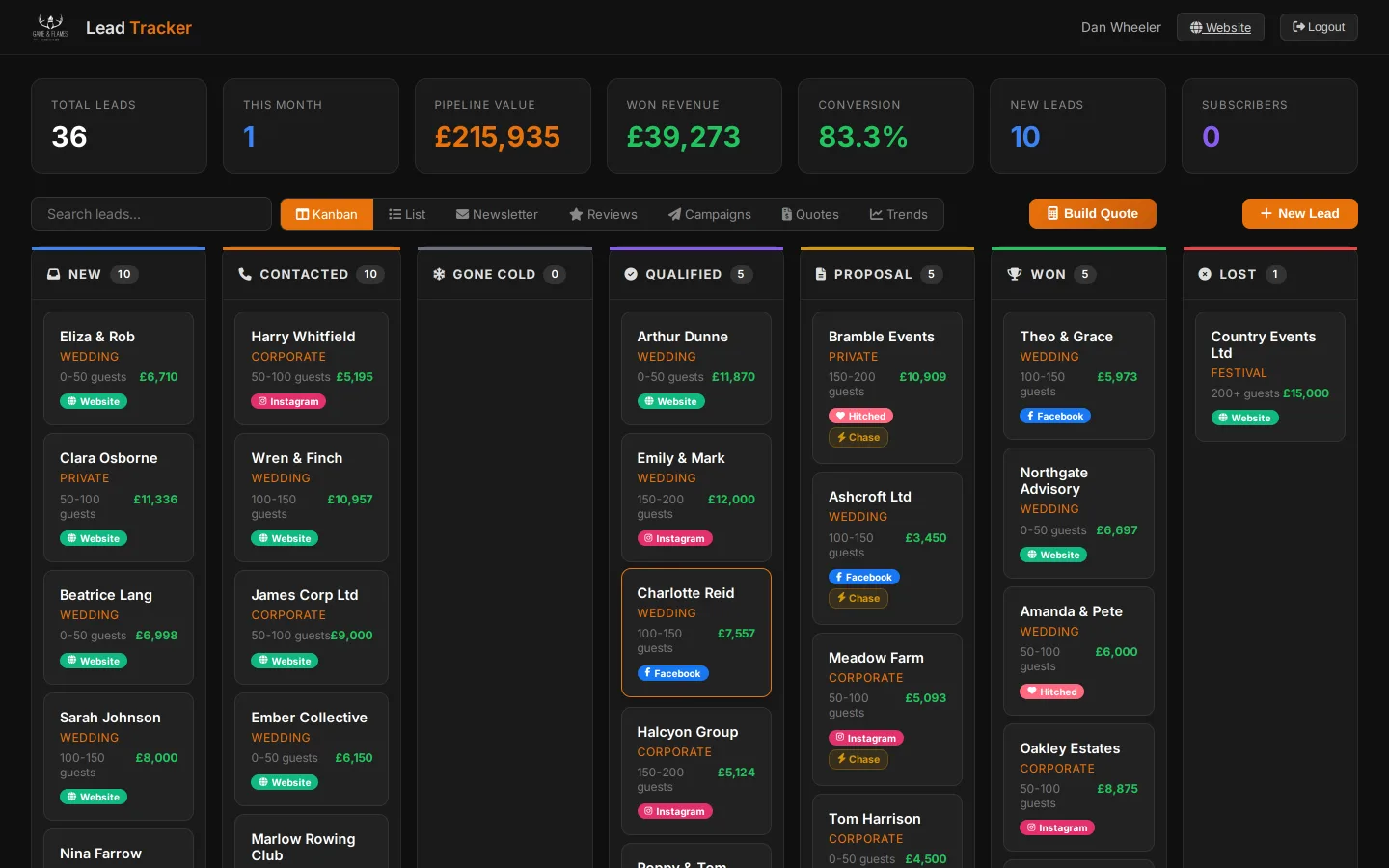
Game and Flames lead tracker, shown with demo data: enquiries sorted into columns from New to Won, with totals for leads, pipeline value and conversion across the top

Lead capture into one pipeline

Before, Game and Flames’ leads arrived by email and got lost, spam drowned the real enquiries, and nobody knew which came from paid social. Now every enquiry lands in one drag-and-drop pipeline, six layers of filtering remove the spam silently, and every lead carries its source, paid or organic. Anything borderline is flagged for a person to check, not deleted. A person still decides what happens next; the pipeline’s job is to make sure they can see everything that’s waiting.

Jobs that run on a timer

Some work just needs doing at the right moment, every time. Live Happy’s platform has a scheduled worker that handles its weekly prompts and takes a backup every night. Barn Gym’s class and PT bookings run automated waitlists. Booking reminders, renewal notices, a nudge when a quote goes quiet, a review request once the job is done: set once, run every time, logged as they go. Anything new that reaches a customer waits for a person’s approval until you decide otherwise.

Campaigns with a sign-off button

Game and Flames had a 2,000-name mailing list doing nothing. We built a broadcast and campaign engine with delivery and open tracking, so the list can earn its keep and the owner can see who read what. The list splits into segments from the CRM, so past customers and new enquiries don’t get the same email. Add an agent and the campaign drafts itself from your news and offers. A person still approves every send, and anyone who opts out stays opted out.

Back office on rails

Payments matched to invoices, bookings confirmed, files named and filed, data backed up. None of it needs a clever person; all of it needs doing. We wire your tools together so these jobs run on their own, log what they did, and stop to ask a person when something doesn’t match. Game and Flames’ platform backs itself up every night and tests the restore, so the backup is known to work before the day it’s needed.

Reports that write themselves

Monday should start with the numbers, not with building them. We pull figures from your CRM, website and finance system into one report that turns up on its own: leads, quotes, wins and where each one came from. Game and Flames’ reporting tracks seven key numbers, with a 90-day chart of organic against paid enquiries, so the owner can see what the ads actually bring in. Hours saved and leads answered go in the report too, because if it isn’t measured, it didn’t happen.


How it works with us

How it works with us

01

The review call

Twenty to thirty minutes. We find where time and money leak, and which fix pays for itself first.

02

A fixed-price proposal

One scope, one price, one date, with the value case written next to the price. No hourly meter running.

03

Built in weeks

You see progress every week on a working link, not a slide. You can change your mind while it is cheap.

04

Handover, or we run it

You own the code, the data and the accounts. Run it yourselves, or we run it for you.

The front line

What we actually use

Older automation was a chain of if-this-then-that rules that broke the first time an email arrived in an unexpected format. We build with model-native automation instead: the AI model reads the messy input itself - the email, the PDF, the voicemail transcript - and works out which steps apply. MCP servers - your tools, wired into the AI - give it a standard way into your CRM, calendar and accounts. Agents take the steps that need judgement; a person takes the ones that need a decision. We run this tooling in production, and every automation we add is one more piece of a single shared memory for the business.

Where this is heading: the business brain

Questions people ask

Questions people ask

What’s the difference between automation and an AI agent?

Automation follows the same steps every time: form arrives, lead goes into the CRM, the right person gets a nudge. An agent handles the steps that need judgement, like reading an email and drafting the right reply. Most jobs need a bit of both, and both stop for a person wherever a customer or a decision is involved.

Can you automate the tools we already pay for?

Usually. If a tool has an API - the socket other software plugs into - or even a decent export, we can wire it in. Sometimes replacing a tool is cheaper than automating around it, and we’ll say so: Live Happy swapped four rented tools for one codebase it owns, hosted for $0 a month in its own Cloudflare account.

What happens if an automation breaks?

It should fail loudly, not quietly. Our automations log every run, and when something doesn’t match they stop and ask a person rather than guess. You can see what ran, when and what it did. If you’d rather not watch it at all, we can run it for you after handover.

Will automation replace my staff?

It replaces the copying, pasting and chasing, not the people. Your team keeps the customer conversations, the judgement calls and the sign-off, and gets back the hours it used to spend moving information from one screen to another. Nobody joined your business to do that.

What does automation cost to run?

The build is a fixed price, agreed before we start. After that, running costs are mostly hosting and AI usage, and hosting on Cloudflare comes to near zero: Game and Flames runs on the free tier. You own the code and the accounts, so there’s no licence fee to us.

Working in Sussex? See AI consultant in Sussex, or the towns we cover in the footer.

Free business review

Tell us what’s slow. We’ll tell you what to fix first.

A call of 20 to 30 minutes. We find the gaps, the leaks and the quick wins, and what each one is worth to you. Fixed price after that, no hourly rates. No 200-page deck.

Or tell us what you want to achieve and Dan will come back to you within one working day. Email dan@danielnicholls.com.